
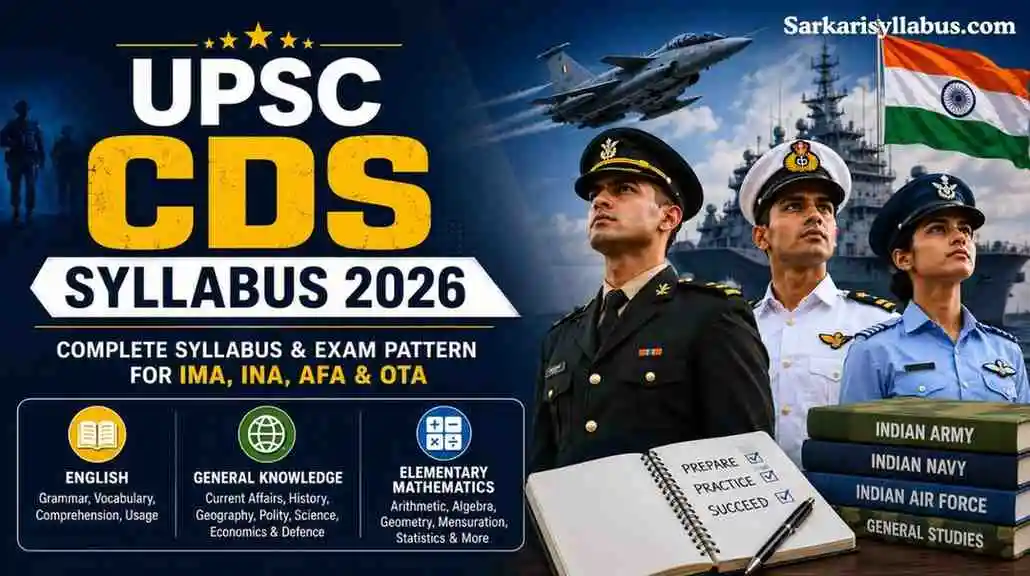
UPSC CDS Syllabus 2026 – Check the complete syllabus for English, General Knowledge, and Elementary Mathematics along with the exam pattern and subject-wise topics in detail. This guide is बेहद useful for preparing for CDS 1 & CDS 2 examinations.
The UPSC CDS Syllabus 2026 is extremely important for candidates preparing for the Combined Defence Services (CDS) examination. Through this exam, candidates are selected for prestigious academies such as the Indian Military Academy (IMA), Indian Naval Academy (INA), Air Force Academy (AFA), and Officers’ Training Academy (OTA). The CDS exam mainly consists of three subjects—English, General Knowledge, and Elementary Mathematics, while for OTA, questions are asked only from English and General Knowledge.
To succeed in this examination, it is essential for candidates to have a clear understanding of the syllabus and exam pattern. Below, the UPSC CDS 2026 syllabus is provided in a detailed, subject-wise format to help you plan your preparation in the right direction.
UPSC CDS-II Exam Pattern 2026
For IMA, INA, and AFA, there are three papers—English, General Knowledge, and Elementary Mathematics, while for OTA, there are only two papers—English and General Knowledge. The detailed exam pattern is explained below, so you can easily understand it and plan your preparation in a better way.
Exam Pattern for IMA, INA & Air Force Academy
| Subject | Duration | Marks |
|---|---|---|
| English | 2 Hours | 100 |
| General Knowledge | 2 Hours | 100 |
| Elementary Mathematics | 2 Hours | 100 |
| Total | 300 |
Exam Pattern for OTA (Officers’ Training Academy)
| Subject | Duration | Marks |
|---|---|---|
| English | 2 Hours | 100 |
| General Knowledge | 2 Hours | 100 |
| Total | 200 |
CDS Exam 2026 – Key Highlights
- All papers are objective-type (MCQs).
- GK and Mathematics papers are available in both Hindi and English.
- Negative marking of 0.33 marks for each incorrect answer.
UPSC CDS Syllabus 2026 (Subject Wise)
The CDS syllabus is divided into three main subjects:
CDS Elementary Mathematics Syllabus 2026 (Code No. 13)
| Section | Topics |
|---|---|
| Arithmetic | Number System (Natural, Integers, Rational, Real Numbers), Fundamental Operations (Addition, Subtraction, Multiplication, Division), Square Roots, Decimal Fractions, Unitary Method, Time & Distance, Time & Work, Percentage, Simple & Compound Interest, Profit & Loss, Ratio & Proportion, Variation |
| Number Theory | Division Algorithm, Prime & Composite Numbers, Divisibility Tests (2, 3, 4, 5, 9, 11), Multiples & Factors, Factorisation Theorem, HCF & LCM, Euclidean Algorithm, Logarithms (Base 10), Laws of Logarithms |
| Algebra | Basic Operations, Factors, Remainder Theorem, HCF & LCM, Polynomials, Quadratic Equations, Relation Between Roots & Coefficients, Linear Equations (Analytical & Graphical), Linear Inequations, Set Theory, Rational Expressions, Laws of Indices |
| Trigonometry | Sine, Cosine, Tangent (0°–90°), Standard Values (0°, 30°, 45°, 60°, 90°), Trigonometric Identities, Trigonometric Tables, Heights & Distances |
| Geometry | Lines & Angles, Plane Figures, Triangle Properties, Congruency & Similarity, Medians & Altitudes, Parallelogram, Rectangle & Square Properties, Circles (Tangents & Normals), Loci |
| Mensuration | Area (Square, Rectangle, Triangle, Circle), Combined Figures, Surface Area & Volume (Cuboid, Cone, Cylinder, Sphere) |
| Statistics | Data Collection & Tabulation, Graphs (Histogram, Bar Chart, Pie Chart), Frequency Polygon, Measures of Central Tendency |
CDS English Syllabus 2026 (Code No. 11)
| Section | Topics |
|---|---|
| Grammar | Parts of Speech, Tenses, Articles, Prepositions, Active & Passive Voice, Direct & Indirect Speech |
| Vocabulary | Synonyms, Antonyms, One Word Substitution, Idioms & Phrases |
| Comprehension | Reading Comprehension Passages |
| Sentence Structure | Sentence Improvement, Error Detection, Sentence Arrangement |
| Usage | Fill in the Blanks, Cloze Test |
CDS General Knowledge Syllabus 2026 (Code No. 12)
| Section | Topics |
|---|---|
| Current Affairs | National & International Events, Awards, Sports, Defence, Important Dates |
| History | Ancient, Medieval & Modern Indian History, Freedom Struggle |
| Geography | Physical Geography, Indian Geography, Climate, Resources |
| Polity | Constitution of India, Fundamental Rights & Duties, Government Structure |
| Economy | Basic Economic Concepts, Budget, Banking, Economic Development |
| General Science | Physics, Chemistry, Biology (Everyday Science) |
| Defence Awareness | Indian Armed Forces, Military Exercises, Defence Technology |
SSB Interview Process (Stage II)
Candidates who qualify the written exam are called for the SSB Interview, which is conducted in two stages:
Stage I
- Officer Intelligence Rating (OIR) Test
- Picture Perception & Description Test (PP&DT)
Stage II
- Personal Interview
- Group Testing Officer (GTO) Tasks
- Psychology Tests
- Conference Round
Important Links
| Sarkari Syllabus | Click Here |
| UPSC Official Website | Click Here |